Skip to product information
1 of 4

Crave Control

Crave Control

Regular price $74.00 USD
Regular price Sale price $74.00 USD
Sale Sold out
Quantity

Crave Control

Description

Crave Control supports the synthesis of the brain reward neurotransmitters (like serotonin and catecholamines) and through its effect on the natural opioids will, by virtue of inhibiting GABA, cause a significant release of dopamine at the nucleus accumbens. This constant release of possibly therapeutic amounts of dopamine leads to proliferation of D2 receptors, thereby promoting appetite suppression and reducing overall craving in general

Functions

Early biochemical textbooks reference certain carboxypeptidase inhibitors, of which one of the most potent amino acids included was D-phenylalanine. Years later, studies of D-phenylalanine demonstrated three important roles for the amino acid: analgesic, anti-inflammatory and anti-craving. Further studies revealed that certain enzymes were responsible for the breakdown of brain opioid peptides. Brain studies indicated that D-phenylalanine inhibited the enzyme, enkephalinase. Injections of D-phenylalanine resulted in inhibition of enkephalinase and higher levels of the brain opioid enkephalin. While D-phenylalanine alone is considered a drug, DL-phenylalanine, which is in Crave Control, is considered a neutraceutical, and is as effective as D-phenylalanine, only at a slightly higher dose. Further studies have demonstrated that low dopamine D2 receptors, and/or low amounts of dopamine released at the synapse in the brain, will lead to craving behavior. It is further understood that if D2 receptors are continually stimulated, a positive feedback will induce the development of additional D2 receptors. Therefore, if D2 receptors are compromised in the human, then stimulating D2 receptors with dopamine will reduce craving behavior. Anti-craving behavior can be induced if there is a means of continually releasing dopamine at the reward site of the brain in the mesolimbic system; and even in a genetically compromised individual, existing craving behavior can be improved. In addition to DL-phenylalanine, Crave Control contains the necessary ingredients to properly utilize DL-phenylalanine and increase dopamine production. Ingredients such as L-tyrosine, L-glutamine, L-5-HTP, Rhodiola rosea and P5P help to ensure that healthy levels of dopamine are encouraged to address "Reward Deficiency Syndrome," which features multiple expressions including overeating and carbohydrate binging. In conclusion, Crave Control causes the synthesis of the brain reward neurotransmitters, such as serotonin and catecholamines. And through its effect on natural opioids, will by inhibiting GABA, cause a significant release of dopamine at the nucleus accumbens. This release of increased amounts of dopamine creates a proliferation of D2 receptors, thereby reducing cravings for carbohydrates. This same improvement in the craving process can also be approached in other behaviors where craving is a major concern

Indications

Crave Control may be a useful dietary supplement in individuals who exhibit dopamine deficient cravings or who are attempting to increase their D2 receptors and dopamine levels in the brain

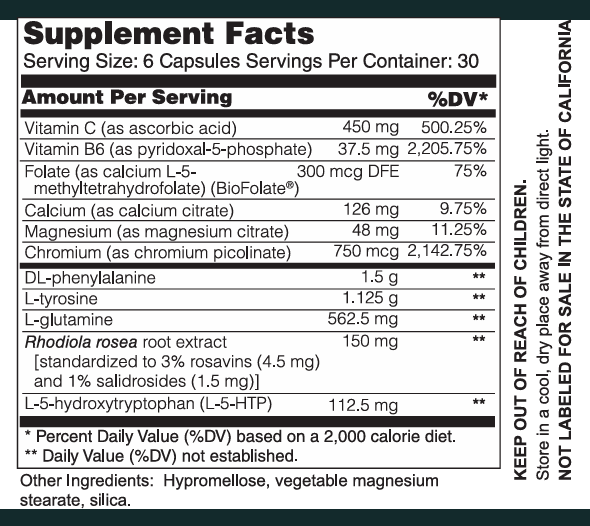
Supplement Facts

Vitamin C (as ascorbic acid) 450 mg
Vitamin B6 (as pyridxoal-5-phosphate) 37.5 mg
Calcium (as calcium citrate) 126 mg
Magnesium (as magnesium citrate) 48 mg
Chromium (as chromium picolinate) 75 mcg
DL-phenylalanine 1.5 g
L-tyrosine 1.125 g
L-glutamine 562.5 mg
Rhodiola rosea root extract [standardized to 3% rosavins (4.5 mg) and 1% salidrosides (1.5 mg)] 150 mg
L-5-hydroxytryptophan (L-5-HTP) 112.5 mg

Other Ingredients: Hypromellose, vegetable magnesium stearate, silica.

Folate ......................................................... 300 mcg DFE

(as calcium L-5-methyltetrahydrofolate) (BioFolate®)

Suggested Use

As a dietary supplement, adults take 2 capsules 3 times per day, 45 minutes before meals, or as directed by a healthcare professional

Storage

Store in a cool, dry place, away from direct light. Keep out of reach of children. Crave Control Nutritional Support for Neurotransmitter Balance

References

  1. Bonavita E. Study of the efficacy and tolerability of L-acetylcarnitine therapy in the senile brain. Int J Clin Pharmacol Ther Toxicol 1986;24:511-6
  2. Bowman BA. Acetyl-carnitine and Alzheimer's disease. Nutr Rev 1992;50:142-4
  3. Brooks JO, 3rd, Yesavage JA, Carta A, Bravi D. Acetyl L-carnitine slows decline in younger patients with Alzheimer's disease: a reanalysis of a double-blind, placebo- controlled study using the trilinear approach. Int Psychogeriatr 1998;10:193-203
  4. Calvani M, Arrigoni-Martelli E. Attenuation by acetyl-L-carnitine of neurological damage and biochemical derangement following brain ischemia and reperfusion. Int J Tissue React 1999;21:1-6
  5. Carta A, Calvani M, Bravi D, Bhuachalla SN. Acetyl-L-carnitine and Alzheimer's disease: pharmacological considerations beyond the cholinergic sphere. Ann N Y Acad Sci 1993;695:324-6
  6. Florio T, Meucci O, Grimaldi M, Ventra C, Cocozza E, Avallone A, Postiglione A, Marino A, Schettini G. Effect of acetyl-L-carnitine treatment on brain adenylate cyclase activity in young and aged rats. Eur Neuropsychopharmacol 1993;3:95-101
  7. Foreman PJ, Perez-Polo JR, Angelucci L, Ramacci MT, Taglialatela G. Effects of acetyl-L-carnitine treatment and stress exposure on the nerve growth factor receptor (p75NGFR) mRNA level in the central nervous system of aged rats. Prog Neuropsychopharmacol Biol Psychiatry 1995;19:117-33
  8. Forloni G, Angeretti N, Smiroldo S. Neuroprotective activity of acetyl-L-carnitine: studies in vitro. J Neurosci Res 1994;37:92-6
  9. Gorini A, D'Angelo A, Villa RF. Action of L-acetylcarnitine on different cerebral mitochondrial populations from cerebral cortex. Neurochem Res 1998;23:1485-91
  10. Gorini A, D'Angelo A, Villa RF. Energy metabolism of synaptosomal subpopulations from different neuronal systems of rat hippocampus: effect of L-acetylcarnitine administration in vivo. Neurochem Res 1999;24:617-24
  11. Hagen TM, Ingersoll RT, Wehr CM, Lykkesfeldt J, Vinarsky V , Bartholomew JC, Song MH, Ames BN. Acetyl-L-carnitine fed to old rats partially restores mitochondrial function and ambulatory activity. Proc Natl Acad Sci U S A 1998;95:9562-6
  12. Hagen TM, Wehr CM, Ames BN. Mitochondrial decay in aging. Reversal through supplementation of acetyl-Lcarnitine and N-tert-butyl-alpha-phenyl-nitrone. Ann N Y Acad Sci 1998;854:214-23
  13. Paradies G, Petrosillo G, Gadaleta MN, Ruggiero FM. The effect of aging and acetyl-L-carnitine on the pyruvate transport and oxidation in rat heart mitochondria. FEBS Lett 1999;454:207-9
  14. Piovesan P, Pacifici L, Taglialatela G, Ramacci MT, Angelucci L. Acetyl-L- carnitine treatment increases choline acetyltransferase activity and NGF levels in the CNS of adult rats following total fimbria-fornix transection. Brain Res 1994;633:77-82
  15. Postiglione A, Soricelli A, Cicerano U, Mansi L, De Chiara S, Gallotta G, Schettini G, Salvatore M. Effect of acute administration of L-acetyl carnitine on cerebral blood flow in patients with chronic cerebral infarct. Pharmacol Res 1991;23:241-6
  16. Salvioli G, Neri M. L-acetylcarnitine treatment of mental decline in the elderly. Drugs Exp Clin Res 1994;20:169-76
  17. Sano M, Bell K, Cote L, Dooneief G, Lawton A, Legler L, Marder K, Naini A, Stern Y , Mayeux R. Double-blind parallel design pilot study of acetyl levocarnitine in patients with Alzheimer's disease. Arch Neurol 1992;49:1137-41
  18. Spagnoli A, Lucca U, Menasce G, Bandera L, Cizza G, Forloni G, Tettamanti M, Frattura L, Tiraboschi P, Comelli M, et al. Long-term acetyl-L-carnitine treatment in Alzheimer's disease. Neurology 1991;41:1726-32
  19. Swamy-Mruthinti S, Carter AL. Acetyl- L -carnitine decreases glycation of lens proteins: in vitro studies. Exp Eye Res 1999;69:109-15
  20. Taglialatela G, Caprioli A, Giuliani A, Ghirardi O. Spatial memory and NGF levels in aged rats: natural variability and effects of acetyl-L-carnitine treatment. Exp Gerontol 1996;31:577-87
  21. Taglialatela G, Navarra D, Cruciani R, Ramacci MT, Alema GS, Angelucci L. Acetyl-L-carnitine treatment increases nerve growth factor levels and choline acetyltransferase activity in the central nervous system of aged rats. Exp Gerontol 1994;29:55-66
  22. White HL, Scates PW. Acetyl-L-carnitine as a precursor of acetylcholine. Neurochem Res 1990;15:597-601

These statements have not been evaluated by the Food and Drug Administration. This product is not intended to diagnose, treat, cure, or prevent any disease.

View full details