Skip to product information
1 of 3

Flax Seed Oil 1000 mg

Flax Seed Oil 1000 mg

Regular price $29.00 USD
Regular price Sale price $29.00 USD
Sale Sold out
Quantity

Flax Seed Oil 1000 mg

Description

Flax seed oil is nature's most concentrated source of alpha linolenic acid (ALA), an essential omega-3 fatty acid. Flax Seed Oil provides 55-60% ALA as well as significant amounts of oleic acid and the essential linoleic acid in their natural triglyceride forms. Flax Seed Oil is extracted without the damaging effects of heat, light and oxygen using a mechanical expeller press. Using this process, the oil never is exposed to temperatures above 96° F, and it retains its natural color and contents of naturally occurring fatty acids, phosphatides, vitamins, minerals and antioxidants. Flax Seed Oil is available as a liquid or in softgel form

Functions

Typical diets in developed countries deliver large amounts of saturated fatty acids and the polyunsaturated omega-6 linoleic and arachidonic acids, and low levels of omega-3 fatty acids. Throughout evolution, humans were accustomed to diets providing roughly equal amounts of omega-6 and omega-3 fatty acids. However, during the last 200 years, the ratio of dietary omega-6 to omega-3 fatty acids increased from about 1:1 to 20-25:1. Leading health professionals now recommend ratios between 4:1 and 10:1. A healthy balance of dietary omega-6 and omega-3 fatty acids appears to be a prerequisite for normal immune function. Dietary linoleic acid (18:2 omega-6) is a precursor to arachidonic acid (20:4) which in turn is a precursor for pro-inflammatory prostaglandin E2 and leukotriene B4, and platelet aggregating thromboxane A2. The omega-3 fatty acid ALA provides a natural counterbalance because it is metabolized to the long chain omega-3 fatty acids EPA (eicosapentaenoic acid) and DHA (docosahexaenoic acid), which serve as precursors for the anti-inflammatory prostaglandins E1 and E3 and decrease the formation of prostaglandin E2 and thromboxane A2. Among other factors, sufficient dietary levels of ALA and other omega-3 fatty acids are also important for healthy mucous membranes, skin and hair. They serve as precursors for steroid production and hormone synthesis

Indications

Flax Seed Oil may be a useful dietary adjunct for those who wish to supplement their diets with omega-3 fatty acids

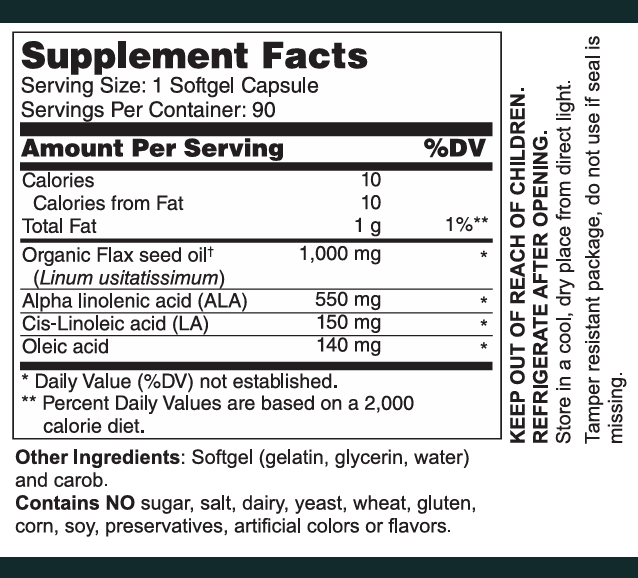
Supplement Facts

One Softgel Capsule Contains

Total Fat 1 g
Organic flax seed oil* (Linum usitatissimum) 1, 000 mg
Alpha linolenic acid (ALA) 550 mg
Cis-linoleic acid (LA) 150 mg
Oleic acid 140 mg

Other Ingredients: Softgel (gelatin, glycerin, water) and carob. * From organic flax seed oil. Flax oil is a source of alpha linolenic acid, cis-linoleic acid and oleic acid.

Calories ........................................................................... 10

Calories from Fat ...........................................................10

This product contains NO sugar, salt, dairy, yeast, wheat, gluten, corn, soy, preservative, artificial colors or flavors.

Suggested Use

Take one 1 softgel capsule, 1 or 2 times daily with food, or as directed by a healthcare professional

Side Effects

No adverse effects have been reported

Storage

Refrigerate after opening. Store in a cool, dry place away from direct light. Keep out of reach of children. Flax Seed Oil 1,000 mg Softgel Capsules Organic/Lignan Rich

References

  1. Allman MA, Pena NM, Pang D. Supplementation with flaxseed oil versus sunflower seed oil in healthy young men consuming a low fat diet: effects on platelet composition and function. Eur J Clin Nutr 1995;49:169-178
  2. Bierenbaum ML, Reichstein R, Watkins TR. Reducing atherogenic risk in hyperlipemic humans with flax seed supplementation: a preliminary report. J Am Coll Nutr 1993;12:501-504
  3. Cunnane SC, Hamadeh MJ, Liede AC, Thompson LU, Woiever TM, Jenkins DJ. Nutritional attributes of traditional flaxseed in healthy young adults. Am J Clin Nutr 1995;61:62-68
  4. De Lorgeril M, Renaud S, Mamelle N, et al. Mediterranean alphalinolenic acid-rich diet in secondary prevention of coronary heart disease. Lancet 1994;343:1454-1459 Galland L. Increased requirements for essential fatty acids in atopic individuals: a review with clinical descriptions. J Am Coll Nutr 1995;5:213-228
  5. Kelley DS, Nelson GJ, Love JE, et al. Dietary alpha-linolenic acid alters tissue fatty acid composition, but not blood lipids, lipoproteins or coagulation status in humans. Lipids 1993;28:533-537
  6. Kelley DS, Branch LB, Love JE, Taylor PC, Rivera YM, Iacono JM. Dietary alpha- linolenic acid and immunocompetence in humans. Am J Clin Nutr 1991;53:40-46
  7. Mantzioris E, James MJ, Gibson RA, Cleland LG. Dietary substitution with an alpha- linolenic acid-rich vegetable oil increases eicosapentaenoic acid concentrations in tissues. Am J Clin Nutr 1994;59:1304-1309
  8. Singer P, Jaeger W, Berger I, et al. Effects of dietary oleic linoleic and alpha-linolenic acids on blood pressure, serum lipids, lipoproteins and the formation of eicosanoid precursors in patients with mild essential hypertension. J Hum Hypertens 1990;4:227- 233

These statements have not been evaluated by the Food and Drug Administration. This product is not intended to diagnose, treat, cure, or prevent any disease.

View full details