PEAk Factor PEA & ALA
Couldn't load pickup availability
PEAk Factor PEA & ALA
Description
Each capsule contains 300 mg of bioavailable palmitoylethanolamide (PEA) (Levagen®+) and 150 mg alpha lipoic acid (ALA). This product does not contain corn, soy, peanuts, gluten or dairy
Functions
PEA is an endocannabinoid-like lipid mediator that is naturally produced as a direct response to inflammatory markers. PEA is found in all tissues, including the brain, and helps to maintain cellular homeostasis. It is produced from membrane phospholipids whenever the body needs to repair muscles or minimize pain. It is produced as a biological response and repair mechanism, potentiating its actions at cannabinoid CB1, CB2 and GPR55 receptors, and TRPV1 channels. Endogenous PEA is generally insufficient to counter chronic allostatic load as seen in chronic inflammatory disorders.1,3 PEA can also become more difficult to produce endogenously with age.3 Increasing endogenous PEA through decreasing its degradation or through exogenous administration has been shown to limit neuroinflammation and to have an analgesic action in models of neuropathic pain.1,2,3.4 Supplemental PEA is often used for joint pain and sports inflammation.5,6,7,8,9 PEA has been studied for the management of mild to moderate osteoarthritis symptoms, in exercise recovery, migraine, and immune support.8,9,10,11 PEA can also contribute to relaxation and restfulness leading to a superior quality of sleep.12 PEAk Factor features cold water dispersible Levagen®+ powered by LipiSperse® to increase absorption. LipiSperse® delivery reduces surface tension and eliminates the usual size absorption problems with standard PEA particles.3 With LipiSperse® technology, the PEA particles can freely disperse in water, have improved bioavailability and greater dose- efficacy. A pharmacokinetics study revealed that Levagen®+ had 1.8 times more bioavailability compared to standard PEA. PEAk Factor also contains 150 mg of alpha lipoic acid (ALA), a very potent antioxidative agent. Oxidative stress is thought to possess a significant role in the pathogenesis of diabetic neuropathy.13 ALA has been shown to improve nerve blood flow, reduce oxidative stress and improve distal nerve conduction in a rat model of diabetic neuropathy.14 Clinical studies investigating the effect of α-lipoic acid on diabetic neuropathy have revealed promising results in terms of neuropathic symptoms.14,15
Indications
PEAk Factor may be a useful supplement with benefits in the areas of pain, inflammation, immune support and sleep
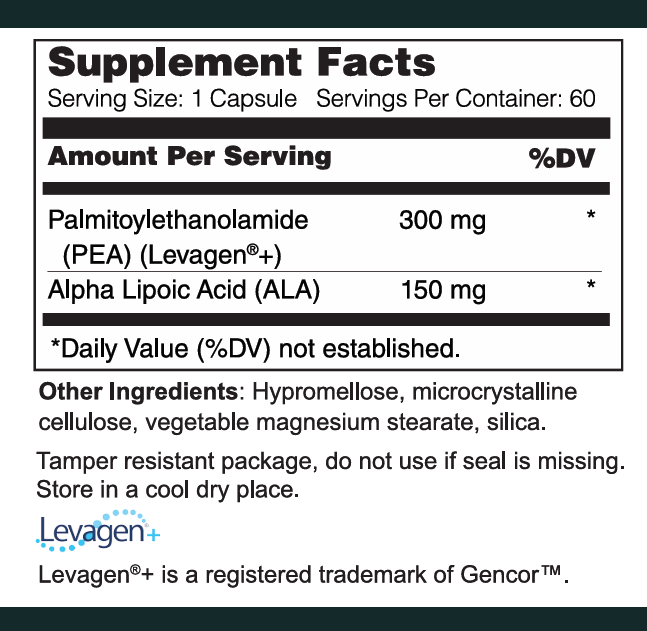
Supplement Facts
1 Capsule Contains
| Palmitoylethanolamide (PEA) (Levagen®+) | 300 mg |
| Alpha lipoic acid (ALA) | 150 mg |
Other Ingredients: Hypromellose, microcrystalline cellulose, vegetable magnesium stearate, silica. Contains NO corn, soy, peanuts, gluten or dairy.
Suggested Use
As a dietary supplement, adults take 1-2 capsules, twice daily, or as directed by a healthcare professional
Side Effects
Generally, well tolerated. Nausea is rarely reported. May lead to improvement in seizure thresholds
Storage
Store in a cool, dry place, away from direct light. Keep out of reach of children
References
- 1. Petrosino S, Schiano Moriello A Palmitoylethanolamide: A Nutritional Approach to Keep Neuroinflammation within Physiological Boundaries-A Systematic Review. Int J Mol Sci. 2020 Dec 15;21(24):9526 doi: 10.3390/ijms21249526. PMID: 33333772; PMCID: PMC7765232. 2. Rankin L, Fowler CJ. The Basal Pharmacology of Palmitoylethanolamide. Int J Mol Sci. 2020 Oct 26;21(21):7942 doi: 10.3390/ijms21217942. PMID: 33114698; PMCID: PMC7662788. 3. Clayton P, Hill M, Bogoda N, Subah S, Venkatesh R. Palmitoylethanolamide: A Natural Compound for Health Management. Int J Mol Sci. 2021 May 18;22(10):5305 doi: 10.3390/ijms22105305. PMID: 34069940; PMCID: PMC8157570. 4
- Petrosino, S., and Di Marzo, V. (2017)
- The pharmacology of palmitoylethanolamide and first data on the therapeutic efficacy of some of its new formulations. British Journal of Pharmacology, 174: 1349– 1365 doi: 10.1111/bph.13580. 5. Steels E, Venkatesh R, Steels E, Vitetta G, Vitetta L. A double-blind randomized placebo controlled study assessing safety, tolerability and efficacy of palmitoylethanolamide for symptoms of knee osteoarthritis. Inflammopharmacology. 2019 Jun;27(3):475-485 doi: 10.1007/s10787- 019-00582-9. Epub 2019 Mar 29
- PMID: 30927159. (Continued on following page) 6. Artukoglu BB, Beyer C, Zuloff-Shani A, Brener E, Bloch MH. Efficacy of Palmitoylethanolamide for Pain: A Meta-Analysis. Pain Physician. PEAk Factor PEA & ALA 2017 Jul;20(5):353-362
- PMID: 28727699. 7. Paladini A, Fusco M, Cenacchi T, Schievano C, Piroli A, Varrassi G. Palmitoylethanolamide, a Special Food for Medical Purposes, in the Treatment of Chronic Pain: A Pooled Data Meta-analysis. Pain Physician. 2016 Feb;19(2):11-24
- PMID: 26815246. 8. Gatti A, Lazzari M, Gianfelice V , Di Paolo A, Sabato E, Sabato AF. Palmitoylethanolamide in the treatment of chronic pain caused by different etiopathogenesis. Pain Med. 2012 Sep;13(9):1121-30 doi: 10.1111/j.1526-4637.2012.01432.x. Epub 2012 Jul 30
- PMID: 22845893. 9. Marini I, Bartolucci ML, Bortolotti F, Gatto MR, Bonetti GA. Palmitoylethanolamide versus a nonsteroidal anti-inflammatory drug in the treatment of temporomandibular joint inflammatory pain. J Orofac Pain. 2012 Spring;26(2):99-104
- PMID: 22558609. 10. Dalla V olta G., Zavarize P., Ngonga G.F.K., Carli D. Ultramicronized palmitoylethanolamide reduces frequency and pain intensity in migraine. A pilot study. Int. J. Neurol. Brain. Dis. 2016;3:1–5 doi: 10.15436/2377-1348.16.019. 11. Chirchiglia D, Cione E, Caroleo MC, Wang M, Di Mizio G, Faedda N, Giacolini T, Siviglia S, Guidetti V , Gallelli L. Effects of Add-On Ultramicronized N-Palmitol Ethanol Amide in Patients Suffering of Migraine With Aura: A Pilot Study. Front Neurol. 2018 Aug 17;9:674 doi: 10.3389/fneur.2018.00674. PMID: 30177906; PMCID: PMC6109682. 12. Rao A, Ebelt P, Mallard A, Briskey D. Palmitoylethanolamide for sleep disturbance. A double-blind, randomised, placebo-controlled interventional study. Sleep Sci Pract. 2021;5(1):12 doi: 10.1186/ s41606-021-00065-3. Epub 2021 Sep 10
- PMID: 34522787; PMCID: PMC8428962. 13. Nagamatsu M, Nickander KK, Schmelzer JD, et al. Lipoic acid improves nerve blood flow, reduces oxidative stress and improves distal nerve conduction in experimental diabetic neuropathy. Diabetes Care 1995; 18: 1160–1167. 14. Ziegler D, Low PA, Litchy WJ, et al. Efficacy and safety of antioxidant treatment with α-lipoic acid over 4 years in diabetic polyneuropathy: the NATHAN 1 trial. Diabetes Care 2011; 34: 2054–2060 15. Ametov AS, Barinov A, Dyck PJ, et al. The sensory symptoms of diabetic polyneuropathy are improved with alpha-lipoic acid: the SYDNEY trial. Diabetes Care 2003; 26: 770–776
These statements have not been evaluated by the Food and Drug Administration. This product is not intended to diagnose, treat, cure, or prevent any disease.
Share