Skip to product information
1 of 3

Phosphatidylserine Complex 500 mg

Phosphatidylserine Complex 500 mg

Regular price $46.00 USD
Regular price Sale price $46.00 USD
Sale Sold out
Quantity

Phosphatidylserine Complex 500 mg

Description

Phosphatidyl Serine Complex softgels contain 500 mg of plant-derived (soy bean) phospholipids supplying 100 mg of phosphatidyl serine (PS). Until recently, PS was only available as a very expensive product derived from bovine sources, with microbiological safety problems. New technology has made it possible to concentrate this important brain nutrient from soy bean lecithin, a safe and well-recognized source of phosphatidyl serine

Functions

Phosphatidyl serine (PS), a phospholipid nutrient, is active in cell membranes and is the major acidic phospholipid component in the membranes of the brain. Membranes are the working surfaces of every cell, carrying out the essential functions of cellular communication and hormonal signal transduction. Nerve cells, in particular, depend on healthy membrane function for normal neurotransmitter metabolism and nerve signal transmission. PS occupies a crucial role in many of these membrane-associated nerve cell processes. The fundamental function of PS is to help maintain proper membrane fluidity, which has major implications on most membrane functions. In the brain, PS helps maintain normal capacity for acetylcholine release and thus is important to the cholinergic neurotransmitter system. PS has similar functions in the dopamine, noradrenaline and serotonin dependent neurotransmitter systems. It is also needed for sodium and potassium transport via its influence on ATPase activity. PS assists in maintaining adequate glucose utilization in the brain. Glucose is the preferred energy substrate for nerve cells which, unlike other cells, are unable to use fatty acids or proteins for energy production. Brain glucose utilization, an indicator of brain activity, often declines during aging. Another related function of PS is its role in controlling the normal balance of stress hormones. PS is involved in the body's response to counterbalance the excessive release of adrenocorticotrophic hormone (ACTH) and adrenaline after physical stress from exercise, while supporting normal growth hormone release at the same time. Dietary PS is efficiently and rapidly absorbed in the intestine, taken up into the blood, and readily crosses the blood-brain barrier to reach the nerve cells of the brain

Indications

Phosphatidyl Serine Complex softgels may be a useful dietary supplement for individuals who wish to support the body's nervous system and brain function

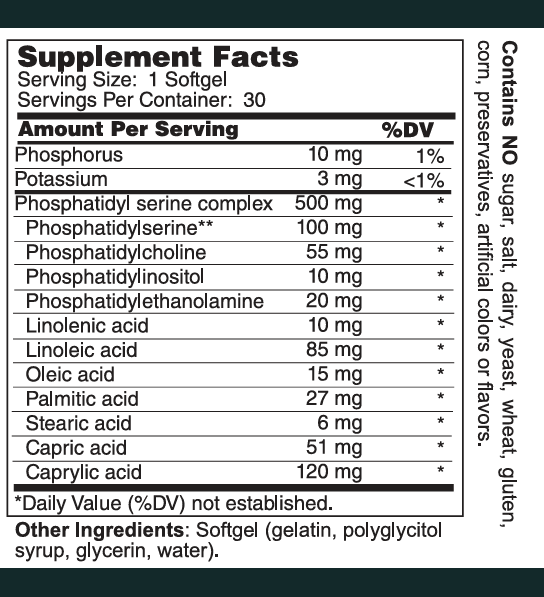
Supplement Facts

1 Softgel Capsule Contains

Phosphorus 10 mg
Potassium 3 mg
Phosphatidyl serine complex 500 mg
Phosphatidylserine 100 mg
Phosphatidylcholine 55 mg
Phosphatidylinositol 10 mg
Phosphatidylethanolamine 20 mg
Linolenic acid 10 mg
Linoleic acid 85 mg
Oleic acid 15 mg
Palmitic acid 27 mg
Stearic acid 6 mg
Capric acid 51 mg
Caprylic acid 120 mg

Other Ingredients: capsule (gelatin, glycerin, and water), soybean oil, carob, and Vitamin E. Serinaid® is a trademark of CHEMI Nutra.

This product contains NO sugar, salt, dairy, yeast, wheat, gluten, corn, preservatives, artificial colors or flavors.

Suggested Use

As a dietary supplement, adults take 1 softgel capsule, 1 to 3 times daily with meals, or as directed by a healthcare professional

Side Effects

No adverse effects have been reported

Storage

Store in a cool, dry place, away from direct light. Keep out of reach of children. Phosphatidyl Serine Complex 500 mg / A Multifunctional Brain Nutrient

References

  1. Allegro L, Favaretto V , Ziliotto G. Oral phosphatidyl serine in elderly patients with cognitive deterioration. Clin Trials J 1987;24:104-108
  2. Amaducci L, Crook TH, Lippi A, et al. Use of phosphatidyl serine in Alzheimer's disease. Ann N Y Acad Sci 1991;640:245-249
  3. Amaducci L, the SMID Group. Phosphatidyl serine in the treatment of Alzheimer's disease: Results of a multicenter study. Psychopharmacol Bull 1988;24:130-134
  4. Caffarra P, Santamaria V. The effects of phosphatidyl serine in patients with mild cognitive decline. Clin Trials J 1987;24:109-114
  5. Cenacchi T, Bertoldin T, Farina C, Fiori MG, Crepaldi G. Cognitive decline in the elderly: A double-blind, placebo-controlled multicenter study on efficacy of phosphatidyl serine administration. Aging Clin Exp Res 1993;5:123-133
  6. Cenacchi T, Baggio C, Palin E. Human tolerability of oral phosphatidyl serine assessed through laboratory examinations. Clin Trials J 1987;24:125-130
  7. Crook T, Petrie W, Wells C, Massari DC. Effects of phosphatidyl serine in Alzheimer's disease. Psychopharmacol Bull 1992;28:61-66
  8. Crook TH, Tinklenberg J, Yesavage J, Petrie W, Nunzi MG, Massari DC. Effects of phosphatidyl serine in age-associated memory impairment. Neurology 1991;41:644-649
  9. Delwaide PJ, Gyselynck-Mambourg AM, Hurlet A, Ylieff M. Doubleblind randomized controlled study of phosphatidyl serine in senile demented patients. Acta Neurol Scand 1986;73:136-140
  10. Engel RR, Satzger W, Gunther W, et al. Double-blind cross-over study of phosphatidyl serine vs placebo in patients with early dementia of the Alzheimer type. Eur Neuropsychopharmacol 1992;2:149-155
  11. Funfgeld EW, Baggen M, Nedwidek P, Richstein B, Mistlberger G. Double- blind study with phosphatidyl serine (PS) in parkinsonian patients with senile dementia of Alzheimer's type (SDAT). Prog Clin Biol Res 1989;317:1235- 1246
  12. Funfgeld EW, Nedwidek P. Neurohomologous phosphatidyl serine in Parkinsonian patients with associated disorders of cerebral metabolism: Results of a pilot study. Clin Trials J 1987;24:42-61
  13. Granata O, DiMichele J. Phosphatidyl serine in elderly patients: An open trial. Clin Trials J 1987;24:99-103
  14. Heiss WD, Kessler J, Mielke R, Szelies B, Herholz K. Long-term effects of phosphatidyl serine, pyritinol, and cognitive training in Alzheimer's disease. Dementia 1994;5:88-98
  15. Heiss WD, Kessler J, Mielke R, Szelies B, Herholz K. Long-term effects of phosphatidyl serine, pyritinol, and cognitive training in Alzheimer's disease. A neuropsychological, EEG, and PET investigation. Dementia 1994;5:88-98
  16. Heiss WD, Kessler J, Slansky I, Mielke R, Szelies B, Herholz K. Activation PET as an instrument to determine therapeutic efficacy in Alzheimer's disease. Ann N Y Acad Sci 1993;695:327-331
  17. Heiss WD, Szelies B, Kessler J, Herholz K. Abnormalities of energy metabolism in Alzheimer's disease studied with PET. Ann N Y Acad Sci 1991;640:65-71
  18. Heywood R, Cozens DD, Richold M. Toxicology of a phosphatidyl serine preparation from bovine brain (BC-PS). Clin Trials J 1987;24:25-32
  19. Klinkhammer P, Szelies B, Heiss WD. Effect of phosphatidyl serine on cerebral glucose metabolism in Alzheimer's disease. Dementia 1990;1:197- 201
  20. Maggioni M, Picotti GB, Bondiolotti GP, et al. Effects of phosphatidyl serine therapy in geriatric patients with depressive disorders. Acta Psychiatr Scand 1990;81:265-270
  21. Monteleone P, Maj M, Beinat L, Natale M, Kemali D. Blunting by chronic phosphatidyl serine administration of the stress-induced activation of the hypothalamo-pituitary-adrenal axis in healthy men. Eur J Clin Pharmacol 1992;41:385-388
  22. Monteleone P, Beinat L, Tanzillo C, Maj M, Kemali D. Effects of phosphatidyl serine on the neuroendocrine response to physical stress in humans. Neuroendocrinology 1990;52:243-248
  23. Palmieri G, Palmieri R, Inzoli MR, et al. Double-blind controlled trial of phosphatidyl serine in patients with senile mental deterioration. Clin Trials J 1987;24:73-83
  24. Pepeu G, Casamenti F, Pepeu IM, Scali C. The brain cholinergic system in ageing mammals. J Reprod Fertil Suppl 1993;46:155-162
  25. Puca FM, Savarese MA, Minervini MG. Exploratory trial of phosphatidyl serine efficacy in mildly demented elderly patients. Clin Trials J 1987;24:94- 98
  26. Ransmayr G, Plorer S, Gerstenbrand F, Bauer G. Double-blind placebocontrolled trial of phosphatidyl serine in elderly patients with arteriosclerotic encephalopathy. Clin Trials J 1987;24:62-72
  27. Rosadini G, Sannita WG, Nobili F, Cenacchi T. Phosphatidyl serine: quantitative EEG effects in healthy volunteers. Neuropsychobiology 1990;24:42-48
  28. Sinforiani E, Agostinis C, Merlo P, Gualtieri S, Mauri M, Mancuso A Cognitive decline in ageing brain. Clin Trials J 1987;24:115-124
  29. Slack BE, Liscovitch M, Blusztajn JK, Wurtman RJ. Uptake of exogenous phosphatidyl serine by human neuroblastoma cells stimulates the incorporation of [methyl-14C]choline into phosphatidylcholine. J Neurochem 1989;53:472-481
  30. Soares JC, Gershon S. Advances in the pharmacotherapy of Alzheimer's disease. Eur Arch Psychiatry Clin Neurosci 1994;244:261-271
  31. Villardita C, Grioli S, Salmeri G, Nicoletti F, Pennisi G. Multicentre clinical trial of brain phosphatidyl serine in elderly patients with intellectual deterioration. Clin Trials J 1987;24:84-93

These statements have not been evaluated by the Food and Drug Administration. This product is not intended to diagnose, treat, cure, or prevent any disease.

View full details