Ir directamente a la información del producto
1 de 3

Acetyl-L-Carnitine 750 mg

Acetyl-L-Carnitine 750 mg

Precio habitual $51.00 USD
Precio habitual Precio de oferta $51.00 USD
Oferta Agotado
Cantidad

Acetyl-L-Carnitine 750 mg

Description

Each Acetyl-L-Carnitine capsule contains 750 mg of pure acetyl-L-carnitine

Functions

Acetyl-L-Carnitine plays a key role in maintaining normal brain and nerve function during aging, as many well-designed human and animal studies have shown consistently. Acetyl- L-carnitine is a naturally occurring metabolite of L-carnitine, and both are present in the diet, particularly in foods of animal origin. In most tissues of the body, both L-carnitine and acetyl-L- carnitine are involved in fatty acid oxidation. They are part of the so-called carnitine shuttle. L-carnitine shuttles fatty acids from the cytosol (the cell fluid) into the mitochondria (the cells' powerhouses) for oxidation and energy production. The main end products of fatty acid oxidation are energy (in the form of NADH) and acetyl groups. Most of these acetyl groups are further oxidized in the mitochondria's Krebs cycle, but some are needed in the cytosol for producing other important metabolites. Acetyl-L-carnitine provides a way to carry these acetyl groups through the mitochondrial membranes back out into the cytosol. In brain and other nerve tissues, this acetyl group export by acetyl-L-carnitine out of the mitochondria into the cytosol is important in maintaining normal levels of acetyl groups for the production of acetylcholine and other acetylated neurotransmitters that are so crucial for normal brain and nerve function. The enzyme that makes acetylcholine from acetyl groups and choline is choline acetyl transferase. The activity of this important enzyme has a tendency to decline with age, causing low acetylcholine levels which in turn are thought to contribute to the impairment of brain function that is associated with aging. Besides maintaining normal acetylcholine levels, several studies indicate other neuroprotective benefits of acetyl-L- carnitine, which may be due to at least three modes of action. First, acetyl-L-carnitine has been shown to maintain cellular membrane stability, and to restore age- related membrane changes. Acetyl-L-carnitine can also act as an antioxidant, scavenging harmful superoxide radicals. Since superoxide can damage membrane lipids, this may explain acetyl-L-carnitine's membrane-protective properties. Second, animal studies indicate that acetyl-L-carnitine preserves normal levels of nerve growth factor in brain tissue during aging. Third, human studies indicate that acetyl-L- carnitine increases cerebral blood flow. In summary, acetyl-L-carnitine is a naturally occurring compound that supports normal brain and nerve function during aging through various mechanisms. These include its actions on acetylcholine synthesis, membrane stability, nerve growth factor production and cerebral blood flow

Indications

Acetyl-L-Carnitine capsules may be a useful nutritional adjunct for individuals who wish to support the body's nervous system and brain function. Our Acetyl-L-Carnitine is manufactured under strict quality control standards and the highest raw material specifications. This ensures that the product is free of unwanted impurities and is the highest purity acetyl-L-carnitine

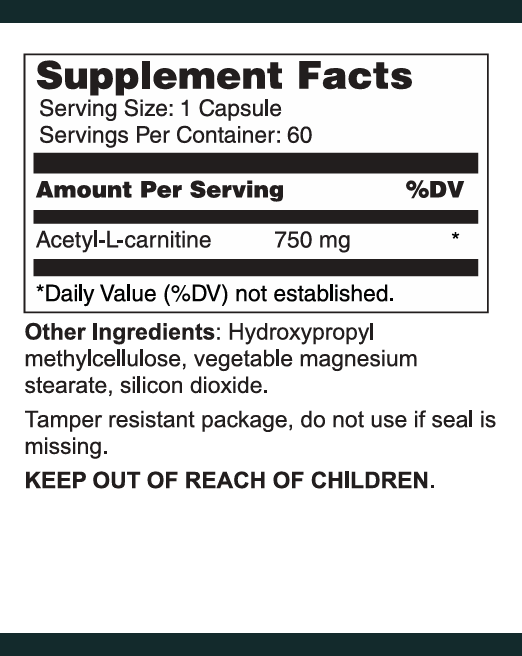
Supplement Facts

1 Capsule Contains

Acetyl L-carnitine 750 mg

Other Ingredients: Hydroxypropyl methylcellulose, vegetable magnesium stearate, silicon dioxide. Dairy-Free, Gluten-Free, Non-GMO, Vegetarian

Suggested Use

As a dietary supplement, adults take 1 capsule 2 times daily, or as directed by a healthcare professional

Side Effects

No adverse effects have been reported. If pregnant, nursing or taking medication, consult your healthcare practitioner before use

Storage

Store in a cool, dry place, away from direct light. Keep out of reach of children. (Continued on following page) Acetyl-L-Carnitine 750

References

  1. Bonavita E. Study of the efficacy and tolerability of L-acetylcarnitine therapy in the senile brain. Int J Clin Pharmacol Ther Toxicol 1986;24:511-6
  2. Bowman BA. Acetyl-carnitine and Alzheimer's disease. Nutr Rev 1992;50:142-4
  3. Brooks JO, 3rd, Yesavage JA, Carta A, Bravi D. Acetyl L-carnitine slows decline in younger patients with Alzheimer's disease: a reanalysis of a double-blind, placebo- controlled study using the trilinear approach. Int Psychogeriatr 1998;10:193-203
  4. Calvani M, Arrigoni-Martelli E. Attenuation by acetyl-L-carnitine of neurological damage and biochemical derangement following brain ischemia and reperfusion. Int J Tissue React 1999;21:1-6
  5. Carta A, Calvani M, Bravi D, Bhuachalla SN. Acetyl-L-carnitine and Alzheimer's disease: pharmacological considerations beyond the cholinergic sphere. Ann N Y Acad Sci 1993;695:324-6
  6. Florio T, Meucci O, Grimaldi M, Ventra C, Cocozza E, Avallone A, Postiglione A, Marino A, Schettini G. Effect of acetyl-L-carnitine treatment on brain adenylate cyclase activity in young and aged rats. Eur Neuropsychopharmacol 1993;3:95-101
  7. Foreman PJ, Perez-Polo JR, Angelucci L, Ramacci MT, Taglialatela G. Effects of acetyl-L-carnitine treatment and stress exposure on the nerve growth factor receptor (p75NGFR) mRNA level in the central nervous system of aged rats. Prog Neuropsychopharmacol Biol Psychiatry 1995;19:117-33
  8. Forloni G, Angeretti N, Smiroldo S. Neuroprotective activity of acetyl-L-carnitine: studies in vitro. J Neurosci Res 1994;37:92-6
  9. Gorini A, D'Angelo A, Villa RF. Action of L-acetylcarnitine on different cerebral mitochondrial populations from cerebral cortex. Neurochem Res 1998;23:1485-91
  10. Gorini A, D'Angelo A, Villa RF. Energy metabolism of synaptosomal subpopulations from different neuronal systems of rat hippocampus: effect of L-acetylcarnitine administration in vivo. Neurochem Res 1999;24:617-24
  11. Hagen TM, Ingersoll RT, Wehr CM, Lykkesfeldt J, Vinarsky V , Bartholomew JC, Song MH, Ames BN. Acetyl-L-carnitine fed to old rats partially restores mitochondrial function and ambulatory activity. Proc Natl Acad Sci U S A 1998;95:9562-6
  12. Hagen TM, Wehr CM, Ames BN. Mitochondrial decay in aging. Reversal through supplementation of acetyl-Lcarnitine and N-tert-butyl-alpha-phenyl-nitrone. Ann N Y Acad Sci 1998;854:214-23
  13. Paradies G, Petrosillo G, Gadaleta MN, Ruggiero FM. The effect of aging and acetyl-L-carnitine on the pyruvate transport and oxidation in rat heart mitochondria. FEBS Lett 1999;454:207-9
  14. Piovesan P, Pacifici L, Taglialatela G, Ramacci MT, Angelucci L. Acetyl-L- carnitine treatment increases choline acetyltransferase activity and NGF levels in the CNS of adult rats following total fimbria-fornix transection. Brain Res 1994;633:77-82
  15. Postiglione A, Soricelli A, Cicerano U, Mansi L, De Chiara S, Gallotta G, Schettini G, Salvatore M. Effect of acute administration of L-acetyl carnitine on cerebral blood flow in patients with chronic cerebral infarct. Pharmacol Res 1991;23:241-6
  16. Salvioli G, Neri M. L-acetylcarnitine treatment of mental decline in the elderly. Drugs Exp Clin Res 1994;20:169-76
  17. Sano M, Bell K, Cote L, Dooneief G, Lawton A, Legler L, Marder K, Naini A, Stern Y , Mayeux R. Double-blind parallel design pilot study of acetyl levocarnitine in patients with Alzheimer's disease. Arch Neurol 1992;49:1137-41
  18. Spagnoli A, Lucca U, Menasce G, Bandera L, Cizza G, Forloni G, Tettamanti M, Frattura L, Tiraboschi P, Comelli M, et al. Long-term acetyl-L-carnitine treatment in Alzheimer's disease. Neurology 1991;41:1726-32
  19. Swamy-Mruthinti S, Carter AL. Acetyl- L -carnitine decreases glycation of lens proteins: in vitro studies. Exp Eye Res 1999;69:109-15
  20. Taglialatela G, Caprioli A, Giuliani A, Ghirardi O. Spatial memory and NGF levels in aged rats: natural variability and effects of acetyl-L-carnitine treatment. Exp Gerontol 1996;31:577-87
  21. Taglialatela G, Navarra D, Cruciani R, Ramacci MT, Alema GS, Angelucci L. Acetyl-L-carnitine treatment increases nerve growth factor levels and choline acetyltransferase activity in the central nervous system of aged rats. Exp Gerontol 1994;29:55-66
  22. White HL, Scates PW. Acetyl-L-carnitine as a precursor of acetylcholine. Neurochem Res 1990;15:597-601

These statements have not been evaluated by the Food and Drug Administration. This product is not intended to diagnose, treat, cure, or prevent any disease.

Ver todos los detalles